Stealth Cam · Review
Stealth Cam DS4K Ultimate Review (2026): The Image-Quality Pick
Spec-based review of the Stealth Cam DS4K Ultimate. 32MP, 4K video, NO-GLO IR, 14-month battery, and zero monthly subscription. The trade-offs that matter.
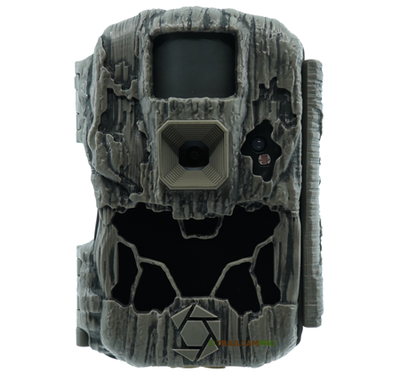
Stealth Cam DS4K Ultimate Review (2026): The Image-Quality Pick
Bottom Line
If photo quality is your goal, this is the move. Buy once, cry once. The trade-off is twelve AA batteries and a walk to swap the SD card.
Who This Is For
If you want the sharpest trail-cam photos available without paying a monthly cellular bill, the DS4K Ultimate is calibrated for you. It targets homeowners and property owners who care more about image fidelity than convenience, who don’t mind walking out to swap an SD card every few weeks, and who’d rather pay once for the hardware than commit to a recurring subscription.
The DS4K Ultimate is the SD-card pick in our buying guide Best Trail Cameras for Backyard Wildlife. The cellular alternative is the Spypoint Flex-M, which trades image quality for app delivery. Pick the DS4K Ultimate when you’re optimizing for what the photos actually look like.
At a Glance
| Spec | Value | Source |
|---|---|---|
| Photo resolution | 32MP (interpolated; native lower) | Stealth Cam listing |
| Photo modes | 32MP / 16MP / 8MP / 4MP selectable | Stealth Cam listing |
| Video | 4K / QHD / 1080 / 720 at 30fps, day & night | Stealth Cam listing |
| Trigger speed | 0.2s rated; 0.48s independently measured | Stealth Cam; Trailcampro testing |
| Detection range | 100ft rated; 70ft measured @ 47.3° angle | Stealth Cam; Trailcampro |
| Burst mode | 1 to 9 photos per trigger | Stealth Cam |
| Flash | 6 x 850nm Power LEDs, “No Glare” matte finish | Stealth Cam |
| Connectivity | SD card only; no cellular, no wi-fi | Stealth Cam |
| Subscription | None | Stealth Cam |
| Storage | Up to 128GB SD card (not included) | Stealth Cam |
| Power | 12 AA batteries OR 12V DC external jack | Stealth Cam |
| Battery life (photo mode) | ~14 months on lithium AAs | Trailcampro measurement |
| Battery life (video mode) | ~2.6 months | Trailcampro |
| Trailcampro overall score | 89/100 (vs Flex-M’s 83) | Trailcampro |
| Trailcampro picture-quality score | 94/100 (vs Flex-M’s 79) | Trailcampro |
| MSRP | $249.99; street price $119.99 to $220.69 | Stealth Cam; Digital Camera World |
What It Does Well
- Image quality is the standout, and it’s not close. Trailcampro’s testing scored picture quality at 94/100, the highest in its category at this price point, and ranked it #1 in their 2022 Flash Range Test. Daytime photos are sharp with strong color reproduction; night shots in the No-Glo IR mode are repeatedly described as “security-camera grade” rather than the muddy black-and-white most budget trail cams produce. If image quality is the reason you’re buying a trail cam, this is the pick.
- Battery life is roughly 4x what cellular trail cams deliver. Trailcampro measured ~14 months in photo mode on Energizer Ultimate Lithium AAs. That’s the kind of “deploy in autumn, check in spring” deployment window that cellular trail cams can’t touch (the Spypoint Flex-M measured ~3.3 months on the same battery type). The trade-off is the 12-AA appetite, which is a real cost ceiling per replacement cycle.
- 4K video at 30fps is a meaningful spec for the price. Most trail cams in the $120 to $220 street price band cap at 1080p. The DS4K Ultimate’s 4K mode produces noticeably more detail in daylight scenes and gives you headroom for cropping or zooming in post. Video at the highest resolution cuts into battery life (~2.6 months), so this is a “best video quality when you want it” feature, not a “leave it on 4K forever” feature.
- The No-Glo IR flash is doing real work. The 6 x 850nm Power LEDs with the matte-finish PIR array means the camera doesn’t visibly glow when triggered at night. For wildlife observation specifically, this matters because many animals notice and avoid Low-Glow or Red-Glow flash sources. Owner reviews consistently flag the night-vision performance as the most upgrade-worthy feature versus their previous trail cam.
- There’s an internal viewing screen for setup and playback. Unlike cellular models that lean entirely on a mobile app, the DS4K Ultimate has a built-in screen for reviewing captures and walking through menu settings on the camera itself. Useful if you don’t want every deployment to require a smartphone within reach.
Where It Falls Short
- The 12-AA battery requirement is a real recurring cost. Most competing trail cams need 6 or 8 AAs. Across a multi-year deployment, the extra batteries add up to noticeably more replacement cost. Owner reviews consistently flag this as the camera’s most-cited annoyance. The 12V DC external power jack is the workaround if you can run a power line to the deployment location.
- Trigger speed is average, not class-leading. The “<0.2s” spec sheet number is optimistic. Trailcampro measured 0.48s in their bench testing, and Digital Camera World describes the speed as “so-so” compared to top competitors at 0.15s. For slow-moving backyard wildlife (deer browsing, raccoons, cats), 0.48s is plenty. For fast-moving subjects close to the camera, you’ll occasionally miss the headline shot.
- 128GB SD card cap is older than the spec sheet on competitors. Some current trail cams (Browning Strike Force, newer Bushnell models) support 512GB cards. The DS4K Ultimate tops out at 128GB. For most backyard use this isn’t a real problem (a 128GB card holds thousands of high-res photos), but if you’re running 4K video continuously or want a “deploy and forget for 6 months” buffer, it’s a ceiling worth knowing about.
- The styling is famously bad. Digital Camera World’s review puts it bluntly: “fell out of the ugly tree.” If the camera is going on a tree in your backyard where guests can see it, the aesthetic is worth knowing. If it’s deployed in the woods behind the house, nobody cares.
- No live preview for framing shots before deployment. The internal screen plays back captures, but per Digital Camera World there’s no real-time viewfinder mode for aiming the camera at a specific spot before walking away. You set it, walk away, and check the first few captures to see what the camera actually sees. Trial-and-error rather than aim-and-shoot.
How It Compares
The DS4K Ultimate is the SD-card pick in our buying guide Best Trail Cameras for Backyard Wildlife. Two natural comparisons:
DS4K Ultimate vs Spypoint Flex-M (cellular alternative). Different categories of camera answering different questions. The DS4K Ultimate beats the Flex-M on every imaging axis: 94/100 vs 79/100 picture quality per Trailcampro, 4K vs 720p video, 100ft (rated) vs 90ft detection range, 14 months vs 3.3 months battery life. The Flex-M beats it on convenience: photos sent to your phone, no SD-card retrieval trips, dual-SIM cellular that works in spotty-coverage areas. Pick the DS4K Ultimate when image quality and battery life matter more than convenience. Pick the Spypoint Flex-M when convenience matters more than image quality.
DS4K Ultimate vs Bushnell CORE DS-4K (closer SD-card competitor). Both are 4K SD-card trail cameras at roughly the same price point. Per Digital Camera World, the Bushnell wins on trigger speed (0.15s vs 0.2s) and styling. The DS4K Ultimate matches or beats on battery life and image quality. If you’ve narrowed the decision to 4K SD-card cameras, this is the comparison that matters most.
Who Should Skip
A trail camera is not a security camera. If your priority is human-deterrent, continuous video recording, or smart-home alarm integration, a dedicated outdoor security camera is the correct category. Trail cams trigger on motion and capture to local storage, not continuous footage.
Buyers who want photos delivered to a phone should look at cellular trail cams instead. The Spypoint Flex-M is the cellular pick in the same buying guide and trades image quality for app delivery.
Anyone with limited patience for changing 12 AA batteries every ~14 months (or ~2.6 months for heavy video use) will be happier with a model that runs on rechargeable internal packs or external 12V DC power.
Verdict
The DS4K Ultimate is the strongest pick when image quality is the deciding factor and a cellular subscription is a non-starter. The 94/100 picture quality score puts it ahead of every cellular competitor in its price tier, the 14-month battery life turns “set and forget” into an actual deployment pattern, and the absence of any subscription means the total cost of ownership is the camera price plus batteries.
If you’d rather have photos on your phone than walk out to swap SD cards, this isn’t the camera; the Spypoint Flex-M is. If you want the best image you can get under $250 without a monthly bill, the DS4K Ultimate is.
FAQ
Q: Will the DS4K Ultimate work without wi-fi or cellular service? A: Yes. The DS4K Ultimate is SD-card-only with no network connectivity. It needs nothing but 12 AA batteries and a microSD card. That’s the entire deployment requirement. It works in deep woods, on properties with no cell service, in apartment buildings, anywhere a battery-powered camera can be mounted.
Q: Is the 32MP rating real, or is it interpolated? A: Per the spec sheet, 32MP is interpolated, not native sensor resolution. That’s standard practice across the trail-cam category (Spypoint’s 28MP, Browning’s 24MP, and most competitor specs are similarly interpolated). The Trailcampro 94/100 picture-quality score reflects what the camera actually produces, not the headline megapixel number. The 4K mode (3840 x 2160) is real and not interpolated.
Q: How often does the SD card need swapping? A: Depends on what you set it to. A 128GB card holds roughly 25,000+ photos at 32MP or roughly 4 to 6 hours of 4K video. For light backyard use (a dozen triggers per day, photo mode only), one card lasts the full battery life of ~14 months. Heavy video use is the limiting case: a daily 30-second 4K clip eats roughly 1GB per day, so a 128GB card fills in roughly 4 months.