Spypoint · Review
Spypoint Flex-M Review (2026): Cellular Without the Subscription Panic
Spec-based review of the Spypoint Flex-M cellular trail camera. Dual-SIM, 100 free photos a month, what owner reviews and independent testing actually say.
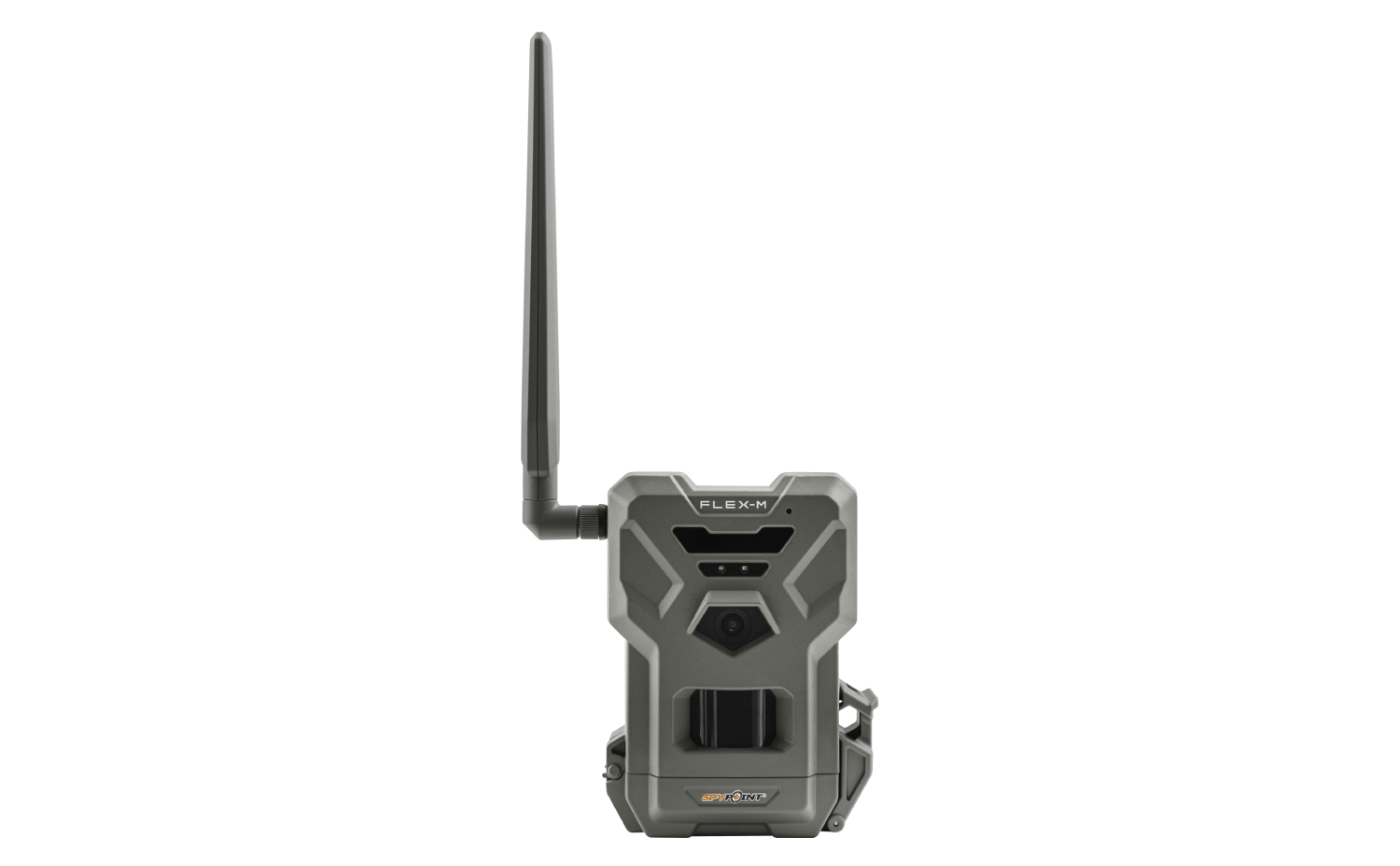
Spypoint Flex-M Review (2026): Cellular Without the Subscription Panic
Bottom Line
Buy it if you want convenience, skip it if you want gallery-quality photos. The Flex-M is the smart starting point if you want cellular trail-cam photos without committing to a monthly bill. The dual-SIM auto-carrier-detection solves the most common cellular failure mode, and the free 100-photo plan covers casual backyard use indefinitely. The caveat is image quality under motion, which is just-okay rather than great.
Who This Is For
If you want cellular trail-cam photos showing up on your phone from a back-of-the-property deployment, and you don’t want to dive into a subscription decision before the camera even arrives, the Flex-M is calibrated for you. It targets homeowners, property owners, first-time cellular buyers, and gift buyers who want the convenience of “set it on a tree, check the app” without committing to a recurring fee on day one.
The free 100-photo-per-month plan covers light backyard use without any monthly commitment. If you only care about what’s walking past once or twice a day, you may never need a paid tier. Heavy daily volume changes the calculation, which is covered below.
At a Glance
| Spec | Value | Source |
|---|---|---|
| Photo resolution | 28 megapixels | Spypoint listing |
| Video | 720p with sound (15-second clips) | Spypoint listing |
| Trigger speed | 0.4s (rated); 0.35s (independently measured) | Spypoint; Trailcampro testing |
| Detection range | 90ft rated; ~120ft measured | Spypoint; Trailcampro testing |
| Flash | Low-Glow LED, ~90ft range | Spypoint listing |
| Cellular | True dual-SIM LTE, preactivated, multi-carrier | Spypoint listing |
| Free plan | 100 photos per month, no commitment | Spypoint |
| Storage | microSD up to 512GB (not included) | Spypoint listing |
| Power | LIT-22 battery pack or 8 AA alkalines; 12V DC external | Spypoint listing |
| Battery life | ~3.3 months on Energizer Ultimate Lithium (photo mode) | Trailcampro measurement |
| Water resistance | IP65 | Amazon listing |
What It Does Well
- Multi-carrier dual-SIM connectivity is the standout feature. The Flex-M’s preactivated dual SIM cards let the camera connect to whichever cellular network is strongest at the deployment location. Owner reviews repeatedly call this out as the reason the Flex-M worked where other cellular trail cams failed. If you’re deploying somewhere that AT&T is weak but Verizon is strong (or vice versa), this is the spec that matters most.
- Setup is the friction-free path most first-time cellular buyers want. Trailcampro’s review describes the setup as something that “shouldn’t take longer than a minute or two, even for folks that hate technology.” That matches the recurring pattern in verified-buyer reviews on Amazon: setup-via-QR-code-then-app is consistently described as straightforward.
- The free 100-photo-per-month plan is real. Per Spypoint, every Flex-M includes a free tier that allows up to 100 photos per month with no fees and no commitment. Light backyard use rarely exceeds that ceiling. Paid plans start at around $5 per month for users who need more capacity.
- Detection performance scores well in independent testing. Trailcampro’s measured 0.35-second trigger speed and ~120ft detection range outperform the spec sheet on both axes, which is a rare direction for trail-cam manufacturer claims to break.
Where It Falls Short
- Image quality under motion shows blur. Trailcampro’s review flags motion blur as a recurring weakness, scoring picture quality at 79/100 against the 83/100 overall score. The 28MP figure is interpolated, not native, and the lens isn’t optimized for fast-moving subjects in low light.
- Transmission to the app is slower than the camera’s local capture speed. Photos hit the camera’s SD card within a fraction of a second of detection, but the cellular upload to your phone runs on cellular-network timing. This isn’t a Flex-M defect; it’s the nature of cellular trail cams. Set expectations: “photos in your app within minutes,” not “live alerts.”
- There is no internal menu or viewer. Configuration runs almost entirely through the Spypoint mobile app. If you want to walk up to the camera and check its settings or recent captures on a built-in screen, the Flex-M is not the camera for you. Compare against models that have a 2-inch screen and on-camera buttons if that’s important to you.
- Subscription-tier confusion shows up in critical reviews. The free 100-photo plan is real, but Spypoint also markets paid tiers for higher photo volume, HD video transmission, and additional features. The most common critical theme in owner reviews is buyer confusion about which features cost extra versus which are free. The simple read: the camera works on the free tier, and you can ignore upgrade prompts unless you actually need more photo volume.
How It Compares
The Flex-M is the cellular pick in our buying guide Best Trail Cameras for Backyard Wildlife. Two natural alternatives in different categories:
Flex-M vs Stealth Cam DS4K Ultimate (SD-card alternative). The DS4K Ultimate has the better imaging story on paper: 32MP native sensor, 4K video at 30fps, longer night-vision range, and zero subscription. It also has none of the cellular convenience. Pick the Flex-M when you want photos delivered to your phone and don’t want to walk out to swap SD cards. Pick the DS4K Ultimate when image quality is the priority and the retrieval trip isn’t a problem.
Flex-M vs Bushnell CelluCORE 20 (another cellular option). Both are mainstream cellular cameras targeting the same buyer. The Flex-M’s dual-SIM auto-carrier-detection is the key differentiator; Bushnell’s subscription model is generally described as simpler-but-required (no free tier). Pick the Flex-M if you want the cheaper monthly bill (or zero) and accept some subscription-tier complexity. Pick the Bushnell if brand familiarity matters more than monthly cost.
Who Should Skip
A cellular trail camera is not a security camera. If your priority is human-deterrent, continuous video recording, or integration with a smart-home alarm system, a dedicated outdoor security camera is the correct category. Trail cams trigger on motion and deliver photos (or short clips), not continuous footage.
Buyers who want live-streaming video should also look elsewhere. Cellular trail cams deliver photos on a delay measured in minutes, not seconds.
If you want maximum image quality without a monthly bill, the Stealth Cam DS4K Ultimate (SD-card, 4K) is the stronger pick in the same backyard-monitoring use case.
Verdict
The Flex-M is the strongest pick for a first-time cellular trail-cam buyer who wants property monitoring without a hard subscription commitment. The dual-SIM multi-carrier feature solves the single most common cellular-trail-cam failure mode (weak signal at deployment location). The free 100-photo plan removes the biggest psychological barrier (commit-to-pay-before-you-know-if-it-works). Independent testing puts trigger speed and detection range ahead of the spec sheet, which is a credibility signal.
If image quality at any cost is what you care about, this is not the camera; the DS4K Ultimate is. If you want cellular delivery and a free plan that covers casual use, the Flex-M is.
FAQ
Q: Will the Flex-M work on a property with spotty cell service? A: That’s the case the dual-SIM technology is designed to solve. The preactivated dual SIM cards switch between major carriers automatically, picking whichever has the strongest signal at the deployment location. Owner reviews repeatedly cite this as the reason the Flex-M worked when other cellular cams didn’t. If you don’t have ANY cellular coverage at the deployment site (true dead zone, no carrier), no cellular trail cam will work. Check service maps for both major carriers at the spot before buying.
Q: Does the free 100-photo plan actually work, or is it bait? A: Per Spypoint, the free tier covers 100 photos per month with no fees and no commitment. Owner reviews confirm this works as described. The catch is that the free tier doesn’t include some features that exist on paid tiers (HD video transmission, faster delivery, etc.). For occasional backyard monitoring, the free tier is genuinely usable long-term. If you want video clips delivered (not just photos), a paid plan is required.
Q: How long do batteries last? A: Independent testing by Trailcampro measured roughly 3.3 months in photo mode using Energizer Ultimate Lithium AAs. Video mode cuts that to roughly 1.9 months. Cold-weather use shortens battery life noticeably. If you’re deploying somewhere with long winters or you want to set-and-forget for a full season, consider the LIT-22 rechargeable pack or external 12V DC power.